First Steps in WebGIS
Our tutorials will show you the basic functions of WIGeoWeb and help you get started!
Welcome to the world of WebGIS!
To make it easier for you to get started with the WebGIS WIGeoWeb software, here is an overview of our First Steps Tutorials. They explain all the basics you need to get started with WIGeoWeb.
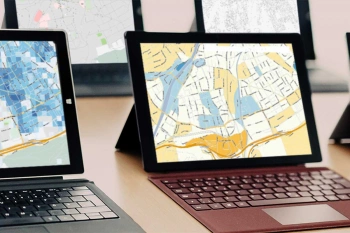
With WIGeoWeb, you can analyze and visualize your data on interactive maps, ideal for market, location, and sales analyses. The software allows you to intuitively recognize spatial relationships and take targeted measures. Whether for retail, real estate, healthcare, or banking – WIGeoWeb offers diverse applications to help you optimize your business processes.
Learn the basic functions and get started with geomarketing and map-based analytics now!
What are the basic functions of a WebGIS?
A WebGIS (web-based geoinformations system/ Online-GIS) uses and combines your company data and market data with geographic data for analysis and visualization of the results on a map.
The central functions of a WebGIS include:
- Interactive map visualization: Users can view their data on the map and explore different areas by panning and zooming.
- Data query and selection: Selection tools allow users to query specific information from the map and to select specific data records.
- Data import and export: Users can upload external data, for example from Excel files, into the system or download existing data for further analysis.
- Create diagrams: With the available data, users can create diagrams to visualize spatial relationships and patterns.
- Advanced search features: Users can perform detailed searches to find specific geographic information.
- Data filtering: Users can set filters to analyze data according to specific criteria.
Our video tutorials guide you through the basic WebGIS features.
Resetting Your Password
Quick guide in bullet points:
- Click on "No access to your account" in the login screen.
- Select the "Password" option.
- Enter username and click submit.
- You will receive an email with a password reset link (check your spam folder).
- Click on the link
- Enter and confirm your new password.
- Save your password.
- Wait for a confirmation email.
- Log in to the WebGIS WIGeoWeb with your new login credentials.
Working with the Map in WebGIS
Overview of the Basic Functions:
- Move the map: Hold the left mouse button down to drag.
- Zoom: Zoom in and out using the mouse wheel.
- Zoom to area: Hold the Shift key and draw a rectangle.
- Set pin: Press and hold the left mouse button until the address is displayed.
- Select customers: Show customer types in the layer tree, then use the selection tool and click on the customers.
- Undo selection: Press the Escape key.
- Deselect a customer: Click on the customer again.
Downloading and Uploading Data from Excel (Example: Sales Territories)
Downloading data:
- Selection of sales territories
- Click the "Download Upload" button in the top right corner.
- Under "Data", select "current selection"
- Select the layer "Sales territories"
- Click "Next"
- Download and open Excel file via the toast message or notifications
Upload Excel files:
- Click the "Download Upload" button in the top right corner.
- Click on the “Upload” tab
- Select a layer for the data upload
- Click on "Upload" in the bottom left corner
- Check the column assignment
- Click "Next"
- Click on "Layer" at the top of the screen and then view data in WIGeoWeb
Generate Charts
Quick guide:
- Select area
- Click on the data table icon in the upper right corner
- Click the small arrow in the top left corner -> the data table expands completely.
- Hold down the left mouse button to draw a box
- Right click to open the chart function
- Select the chart type
- The chart is generated and displayed
- Click on the arrow to download the chart
Grouping Data
Quick guide:
- Click open at the top of the screen.
- Click the “Data Table” button.
- The data table opens at the bottom of the screen.
- To start grouping: Scroll all the way to the left in the data table.
- Click the “Group” button and group sales objects by their respective sales regions.
Advanced Search (Example: Customer Layer)
Quick guide:
- Click the magnifying glass at the top of the screen
- Select the "Customers" data layer
- Click on the "Datasheet" symbol
- Enter the search criteria and click "Search"
- The hits are displayed
Dependent Filters
Quick guide:
- Load the customer layer in the WebGIS.
- Click on the filter icon to open a window for creating different filters. In this example: Sales regions.
- Set the first dependent filter: Select "Northern Germany".
- Set the second dependent filter: "Böttcher sales territory".
- Click on "Filter data".
- Only data matching the dependent filters are displayed.
Transferring Selections
Quick guide:
- In the data table, select the area on the “Catchment Areas” layer.
- The selected areas are highlighted in orange.
- In the data table, click the "Transfer Selection" button.
- Assign the selected ZIP Code by clicking on the “Edit data” pencil icon.
- Select a column from the data table for editing. In this example: “Sales territories”.
- Enter the name of the new sales representative, save, and confirm.
Do you want more personalized WebGIS support?
What data is used in geomarketing?
For geomarketing analyses in GIS software, the following data can and should be used:
- In-house company data: Your own data, such as locations, territories, sales figures, customer survey results, etc., is entered into the geomarketing software via upload or API interface.
- Geodata: This data establishes a spatial reference. It is the foundation for spatial analyses.
- Market data: Socio-demographic data, e.g., on population, age, buyer type, etc., helps to identify the target group and potential customers.
- Industry data: Valuable for the B2B sector to identify potential.
- Location data: Retail companies can assess locations using location factors.
Do you have more questions about market and geodata?
Map-based analyses in WIGeoWeb - further information
Data Integration in GIS and ETL Processes
You want to display, link and analyze data on interactive maps? The ETL process and data integration into the GIS software makes it possible. WIGeoGIS can do all of that and more!

WebGIS - Enter, edit and visualize data
Enter, process and visualize data - WIGeoWeb is ideal for it all. You always have up-to-date and accurate data. You can create point data, line data and areas automatically and manually in WebGIS.

Analyze Data with WIGeoWeb
With WebGIS, you can analyze data intuitively and get understandable results. The georeference reveals information that traditional tools can not show you.

Successfully Manage WebGIS
The WIGeoWeb CMS makes the administration of WebGIS easy. User management, the configuration of functions for individual data layers and the presentation of geodata are all easily controlled using your web browser.
First Steps in WebGIS? We are happy to help you!
Are you already using WIGeoWeb and have questions that weren't answered in the tutorials?
- Simply contact your customer representative
- Or email us your question