
Geographic Market Analyses in Competition Law
Catchment Areas and Isochrones for Merger Control Proceedings
In merger control procedures, the market concentration is often estimated by analyzing catchment areas of the participating companies, so-called isochrones. WIGeoGIS tools and know-how have proven extremely helpful for the calculation and presentation of these analyses.
Case Study Overview
Customer: Schoenherr Attorneys at Law
Application: Competition law, merger control proceedings
Product: Custom geographic market analysis
Goal: Assessment of market concentration, preparation of well-founded data for submission to the competition authorities
“With WIGeoGIS as our partner, we receive a faster, better and more cost-effective database for our work with the competition authorities. This contributes significantly to transparency and success in merger control proceedings.”
Dr. Hanno Wollmann, Schoenherr Attorneys at Law
In-depth market analyses for merger control, antitrust proceedings, and M&A projects
Company mergers must be approved by the competition authorities if they reach a specific size. Depending on the sales, responsibility lies either with the European Commission or at national level.
The national competition authorities, such as the German Federal Cartel Office or the Austrian Federal Competition Authority, primarily focus on the small-scale consideration of local markets in numerous industries, such as retail or building materials. In such cases, isochrones have become established as the preferred analysis tool for estimating the market concentration.
Overlap Analysis Using Isochrones
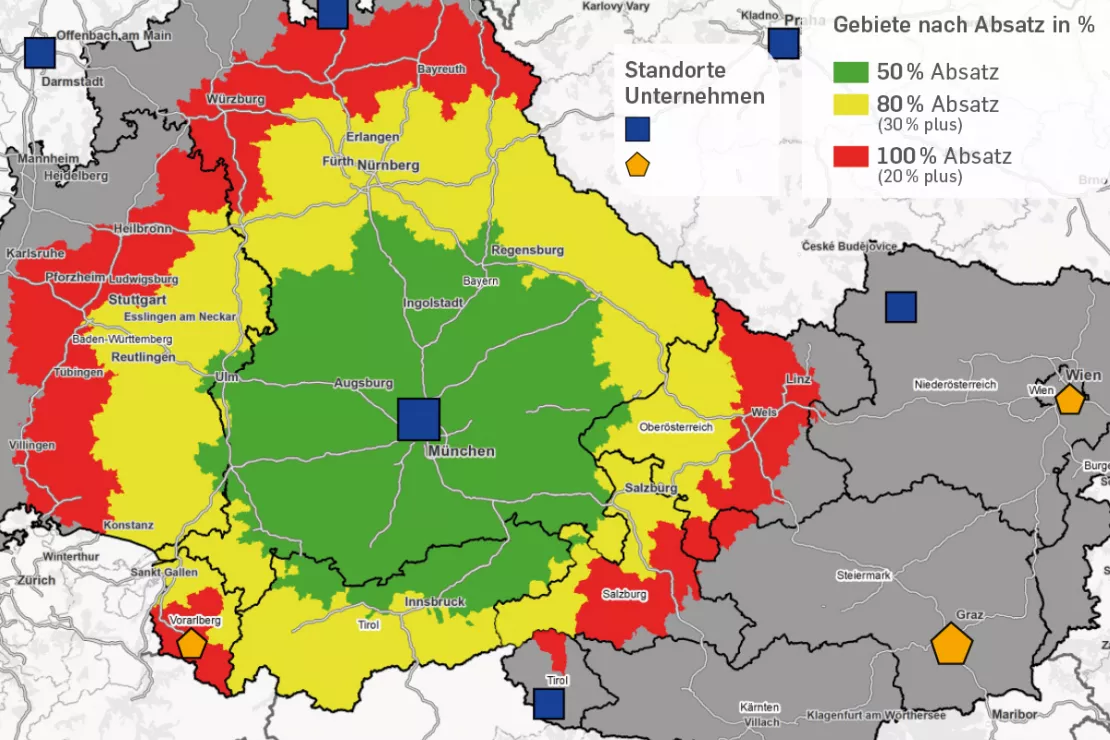
Isochrones are catchment areas of production and distribution locations, measured in distances or travel times. “A common question is how large is the area in which 80% of the customers of a manufacturing facility are located, or in other words, the location where 80% of its sales are generated,” explains Hanno Wollmann, Partner at Schoenherr Attorneys at Law in Vienna and expert in the field of competition law.
“When working with the competition authorities, it is ideal if the calculated isochrones can be displayed on a map. That way, officials can see at a glance where there is overlap between the catchment areas of the companies involved and in which regions the case is harmless from the outset. This is a first step where the geomarketing experts from WIGeoGIS can make our job much easier,” says Wollmann. “For them, making maps that tell you how far you can drive from a specific location in 30 or 60 minutes by car is easy.”
Geographic Market Analysis
It gets exciting where the isochrones of two locations overlap, because the market shares in the overlapping areas are decisive for the competition authorities. For this purpose, the isochrones are supplemented with the sales data of the locations (sales in euros or sales in units or quantities) and calculated in relation to the total market volumes. “With their programs, WIGeoGIS can process the raw data from our customers and link it with the isochrones much more easily than we ever could,” explains Wollmann. In addition, the company can provide data on total market volumes with the data they are able to access for example through Statistics Austria or Eurostat.
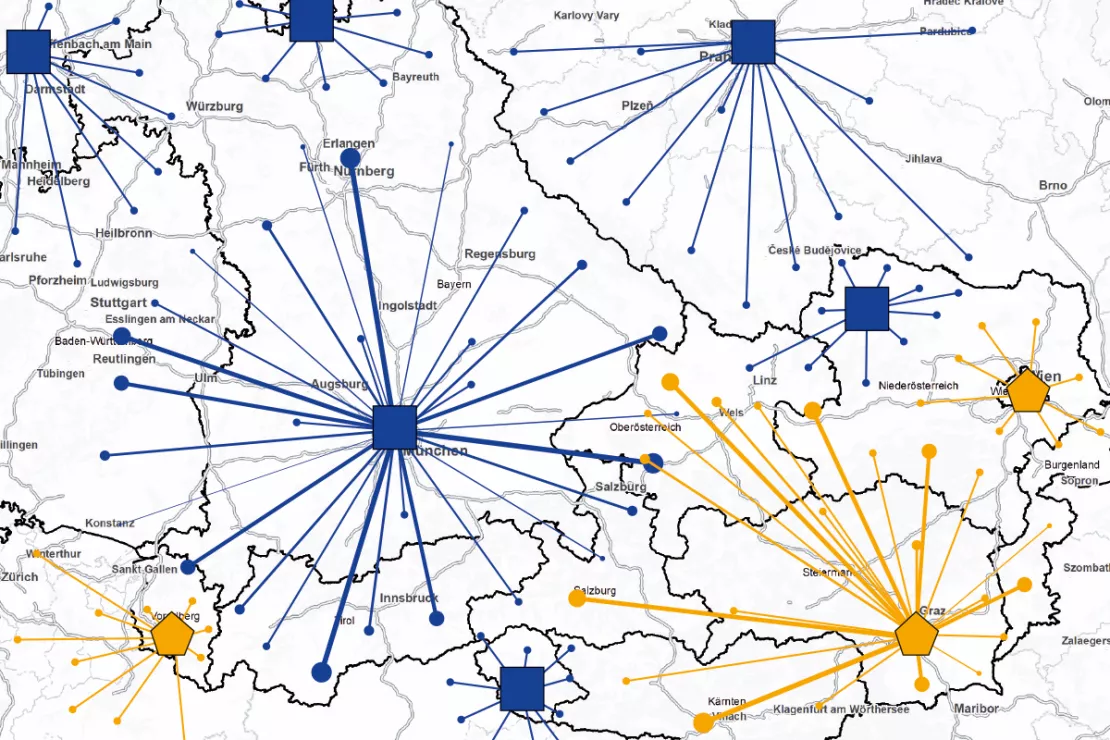
Initial situation of a company merger. The blue locations are owned by the company A. The orange locations are potential merger locations with Company B. The lines represent the current sales streams for each location. The map shows regional markets without overlap and those regions served by both companies. These are of interest in terms of competition law.
Request a Geographic Market Analysis for Your Merger Review Proceedings
Custom Methods
“We have a multitude of tools, methods and data sources,” adds Kai Barenscher, Senior Consultant at WIGeoGIS, looking back on a series of successful projects in competition law. “Together with the client, we calculate different variations and find the best method for each individual case, often after several iterations.” He explains what he means with the help of an example: “Instead of working with political districts, road network-based catchment areas often lead to more reliable key figures for the client. At the same time, this is more realistic, because in real life the street I take to reach a hardware store is more important than the district border.”
“With WIGeoGIS as our partner, we receive a faster, better and more cost-effective database for our work with the competition authorities. This contributes significantly to the transparency and success of merger control procedures,” summarizes Wollmann.
WIGeoGIS Managing Director Wolf Graf sees the topics of mergers & acquisitions and competition law as a good example of the fact that the universal tools from geomarketing can be applied to a wide range of topics. “This explains why even ʻold hands’ in geomarketing are opening up a new business field after more than 25 years.”
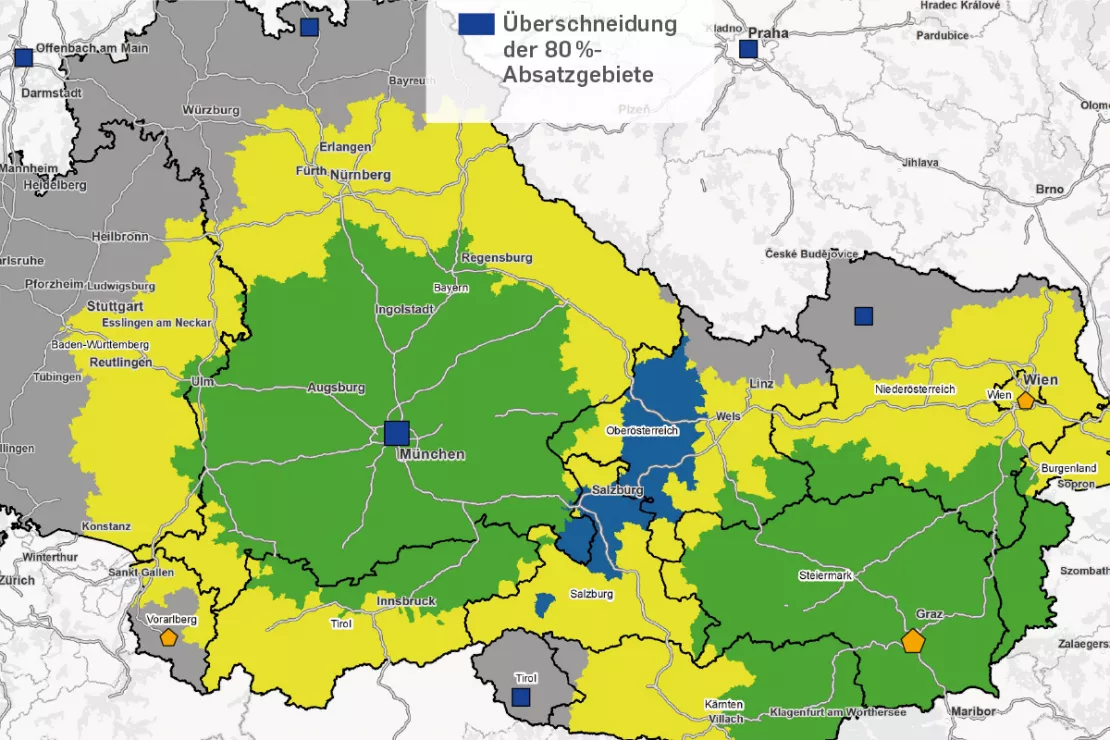
Yellow and green together show the market in which 80% of the sales of the respective location are made. The blue area is the result of the market definition analysis and represents the overlap area of the two 80% isochrones. The area is under the influence of both locations and, in the case of a merger, requires a competitive assessment.
Market Analysis: Request a free initial consultation
- Get expert advice now
- Free of charge and with no obligation
- Consultation via online meeting or phone
Learn more about WIGeoGIS products* and services.

Market analysis - further case studies and information

Crédit Agricole: Market potentials via GIS
To keep up with the constantly growing needs of microgeographical analyses, the Polish subsidiary of Crédit Agricole uses a GIS by WIGeoGIS.

Market Analysis Tool
How to successfully perform 6 different analyses. Anyone who does business, must know their market. WIGeoWeb helps to answer the question of WHERE.

Analyze Market Penetration
With geomarketing you can find potential customers, turnover and sales! Compare your company key data with current market data on a small scale.
FAQ
-
What Is a Geographic Market Analysis in Antitrust Law?
A geographic market analysis determines the geographic areas in which companies compete with one another. It is an important component of antitrust and competition analysis. Regulatory authorities and law firms use it to assess market concentration and identify where companies' markets overlap. The analysis is based on the locations of production and distribution facilities, as well as the geographic areas from which customers originate.
-
How Are Geographic Markets Defined in Merger Control?
In competition law, a geographic market encompasses the area in which the undertakings concerned compete under sufficiently homogeneous conditions of competition. In practice, this often involves analyzing the catchment areas of production sites, distribution centers, or retail locations, measured by distance or travel time. A frequently used approach is to identify the geographic area from which 80% of a facility’s customers are drawn. This analysis provides a basis for defining the relevant geographic market and evaluating potential competitive overlaps arising from a merger or acquisition.
-
What role do isochrones play in merger control proceedings?
Isochrones are lines representing equal travel time or distance from a given location. They visualize the catchment areas of production and distribution sites. This makes it possible, for example, to determine how far an area around a plant extends in which a certain proportion of customers is located. Unlike a simple radius, they take the actual road network into account. That is why they are a highly transparent tool in merger control proceedings. In our projects, we very often start by calculating large distance matrices, tracing routes from demand locations to all regional units within the sales markets. This enables us to respond quickly to changing requirements as the project progresses. We can very quickly calculate the competitive implications, regardless of whether an entire network of locations or just a subset is included in a merger.
-
How can market overlaps be identified and market concentration measured?
To identify market overlaps, the service areas (isochrones) of the companies involved are superimposed on a map. This allows regulatory authorities to see at a glance where the areas overlap and where the merger could affect competition and thus influence market concentration. In addition, sales data can be linked to the isochrones and compared to the total market volume. Market shares in the overlapping areas can be derived from these values. To assess future market concentration, we often calculate the Herfindahl-Hirschman Index (HHI) for the overlapping areas. This measures the degree of concentration in a market.
-
What data sources are suitable for market definition analyses?
Two types of data are combined:
- Company data: locations, revenue, and sales volumes of the companies involved.
- Market data: from public statistics, such as those from Statistics Austria, the Federal Statistical Office, and Eurostat.
In addition, a road network is used to calculate travel times and isochrones.
-
What is WIGeoGIS’s project workflow for market analyses under competition law?
During the initial consultation, the requirements of the case and the necessary data set are agreed upon. WIGeoGIS then investigates whether suitable data for modeling a regional aggregate market is available or whether the companies can provide this data.
In the first part of the analysis, we determine how and where market concentration will change significantly as a result of a merger. Afterward, we can run further simulations to achieve the best possible outcome for the client. We provide the competition authorities with transparent and well-founded documentation.